
Dust Collector
Duct Design
How to calculate CFM, size every duct run and lay out an efficient dust collection system, with Nordfab® Quick-Fit® clamp-together duct that installs in half the time.
- CFM & sizing chart
- Step-by-step layout
- System design at no charge
Prefer a printable copy? Read the duct design guide (PDF)
- Diameters
- 3"–24"
- Install time
- ½ of flanged
- Clamps
- Tool-free
Clean, safe and productive by design
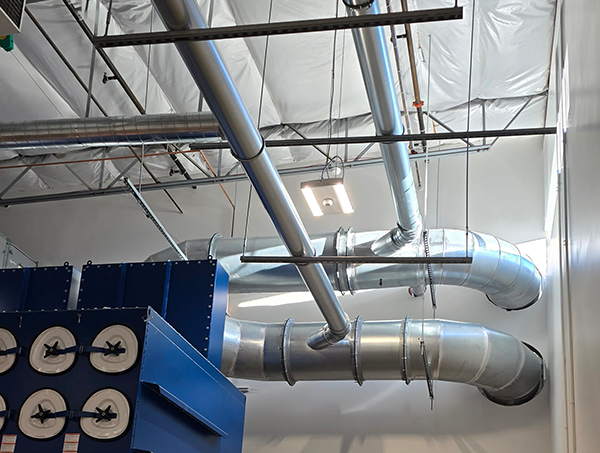
An efficient dust collection system keeps a workspace clean, safe and productive, whether it's a woodworking shop, an industrial plant or any space where dust builds up. The ductwork is what makes it work: it carries dust from every machine to the collector with as little air resistance as possible.
Nordfab® dust collection ductwork is available in pipes and fittings from 3" to 24" in diameter. Its double-rolled connecting edges clamp together without extra fasteners, which makes installation, modification and maintenance simple, and it's built for high air pressure to minimize static pressure loss.
How dust collection ductwork works
Think of it like a vacuum cleaner: the ductwork is the hose and wand that draws dust away from each machine, and the dust collector is the vacuum body that filters it, returning clean air to the building or venting it outside.
- 3" – 24" diameters
- Tool-free clamps
- Low static pressure loss
- Easy to reconfigure
5 Steps to Design Your
Dust Collector Ducting
Follow these steps to plan a system that moves enough air at every machine without overloading your collector. Or skip the math and let our team do it for you.
Assess your space & CFM
Note ceiling height, obstructions and electrical service. Measure each machine’s dust port and look up its CFM; machines with several ports add together.
Draw a top-down layout
On grid paper, mark the exact location of every dust port and write its CFM requirement beside it. Put the highest-CFM machines closest to the collector.
Calculate total system CFM
Add up every port. If the total exceeds your collector’s capacity, use blast gates to close off machines that aren’t running.
Sketch the main duct line
Route the main trunk so a branch can drop directly above each dust port, keeping runs as short and straight as possible.
Size every duct run
Start at the machine farthest from the collector and work back, adding CFM at each branch until the trunk matches the collector inlet.
Or let us design it
Send your sketch and we’ll return a CAD drawing, parts list and quote at no charge. Start here →
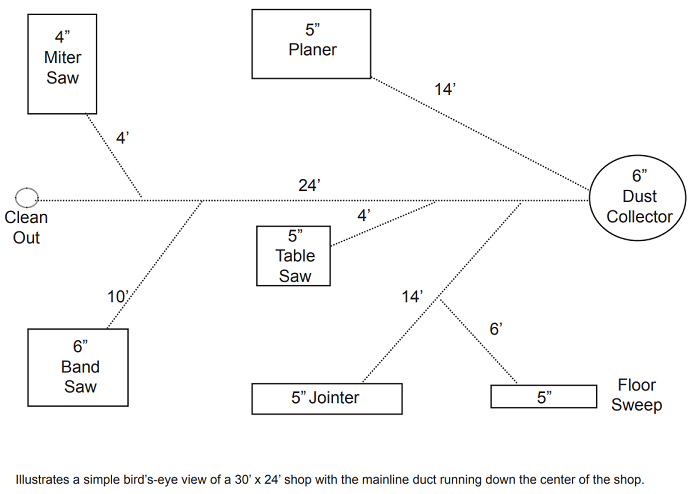
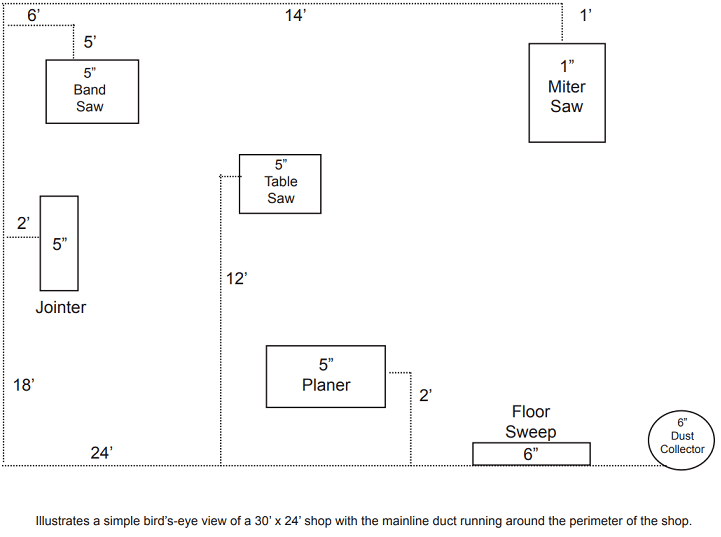
How to size each duct run
- Start at the farthest machine. Use the chart to find the duct size for its CFM. For example, a machine needing 395 CFM takes 4" duct.
- Add CFM where branches join. If the next machine has a 3" port (220 CFM), the main after that junction carries 220 + 395 = 615 CFM, so it steps up to 5" (614 CFM). That branch is a 5-3-4: a 5" main reducing to 4", with a 3" branch leaving the side at 30°. A 60° elbow then turns the branch perpendicular.
- Round to the closest size. If a CFM value falls between chart sizes, choose the closest pipe size.
- Repeat until you reach the collector. For example, adding another 395 CFM machine to the 5" (615 CFM) trunk gives 1,010 CFM, which calls for 7" duct. If that machine will be isolated with a blast gate, you don't need to add its volume and the 5" trunk can stay as is.
Inlet diameter & CFM chart
Measure the diameter of each machine’s dust port and read across to its CFM. Heavier or stickier materials may need more airflow; our design team will confirm for your application.
Hard Duct vs. Flexible Hose
Dust collector ductwork falls into two categories. Most systems use hard metal duct for every main and branch run, with flex hose only at the machine.
Hard, fixed ducting
- Plastic, galvanized steel or stainless steel, depending on the application
- All-metal duct is used in nearly every industrial and commercial system
- Smooth, rigid interior minimizes static pressure loss over long runs
- Metal construction reduces the risk of static electricity
Flexible hose ducting
- Rubber or plastic with a metal grounding helix
- The helix must be grounded at both ends to prevent static and sparks
- Rough interior causes significant static pressure loss and higher energy use
- Best limited to machine connections and other short runs
Nordfab® Quick-Fit® vs. Flanged Ducting
Quick-Fit® is faster and more flexible for dust collection and exhaust. Flanged holds a tighter seal on higher-pressure process lines. We’ll spec the right one for each run.
| Nordfab® Quick-Fit® | Flanged ducting | |
|---|---|---|
| Best for | Dust collection, fume & exhaust | Higher-pressure process lines |
| Joint | Rolled edge + tool-free clamp | Bolted, gasketed flanges |
| Install time | Less than half the time | About twice as long |
| Changes | Unclamp and rearrange quickly | Unbolt; slower to move |
| Existing ductwork | Adds on easily | Needs matching flanges |
Ducting designed for your industry
Let our team design your dust collection system
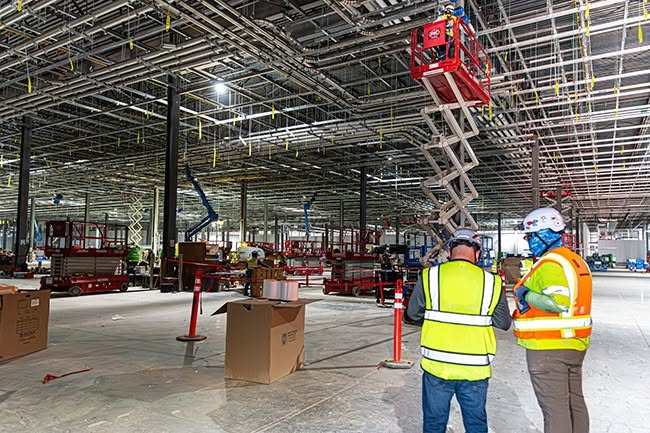
Send us your questionnaire and a rough sketch of your space. Our design team will size every run, pick every fitting and return a complete project package at no charge.
- Professional CAD drawing
- Exact parts list
- Installation instructions
- Budgetary project quote
System design service at no charge
Tell us about your project and our design team will follow up with next steps.
Loading form…
Have a full layout? Use the design questionnaire →
FAQs: Dust Collector Ductwork Design
How do I design a dust collector duct system?
Assess your space, find the CFM each machine needs from its dust port size, draw a top-down layout, add up the total airflow, then size each duct run starting from the machine farthest from the collector. Or send us your layout and our team will design it at no charge.
How much CFM do I need?
Measure the diameter of each machine's dust port and look up its CFM (for example, a 3" port needs about 220 CFM and a 4" port about 395 CFM). Add all ports together for the system total, and subtract any machines that will be isolated with blast gates.
What types of dust collector ducting are there?
There are two main types: hard, fixed ducting made from plastic, galvanized steel or stainless steel, and flexible hose made from rubber or plastic with a grounded metal helix. Metal hard duct is used for nearly all industrial and commercial runs; flex hose should be limited to short machine connections.
What is Nordfab® Quick-Fit® ducting?
Quick-Fit® is Nordfab's modular, clamp-together duct system. Each section has a rolled edge joined with a tool-free clamp, so it installs in less than half the time of flanged duct, aligns precisely and can be reconfigured easily.
When should I use flanged duct instead of clamp-together?
Quick-Fit® clamp-together duct suits most dust collection, fume, and exhaust systems. Higher-pressure processes call for flanged duct, because bolted, gasketed flanges hold a tight seal where clamped joints can begin to leak. Our design team will specify the right connection for each run.
Can Nordfab® ducting systems be reconfigured?
Yes. Quick-Fit® duct can be taken apart, moved and expanded to match changes in your layout, and it can be added to existing ductwork.
Does dust collection ductwork need to be grounded?
Yes. All dust collection systems must be grounded to prevent static buildup in the ductwork or filter. Flexible hose must have its metal helix grounded at both ends.