
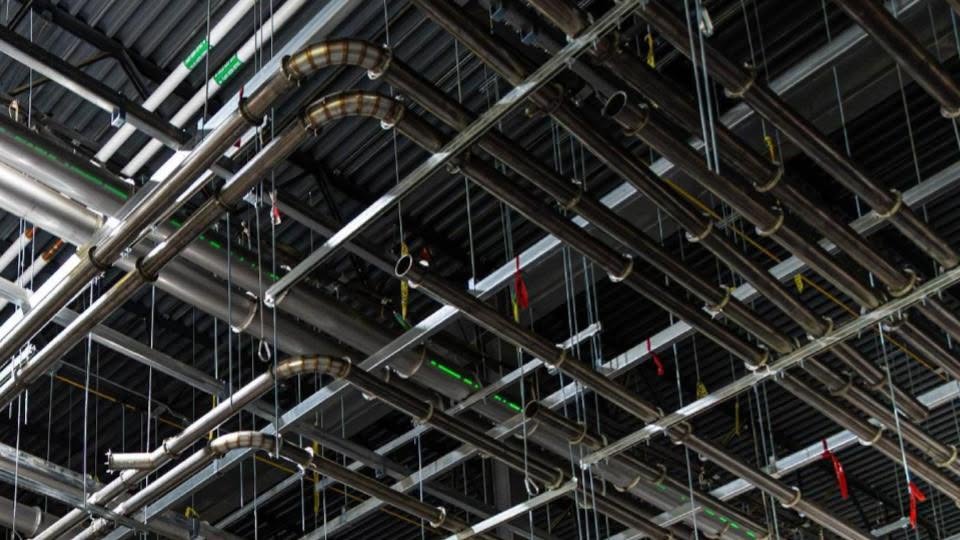
Stainless Steel vs. Galvanized Ductwork
Which one is right for your facility? How the two most common duct materials compare on corrosion, durability, cost and upkeep.
Stainless steel and galvanized steel are the two most common materials for industrial and commercial ductwork. Stainless resists acids, moisture and chemicals, which makes it the standard for food processing, pharmaceutical and high-sanitation settings. Galvanized is a zinc-coated, lower-cost option for general dust collection, woodworking and most indoor or outdoor runs.
- Stainless for wet, corrosive, sanitary, coastal or chemical-exposure applications.
- Galvanized for general dust and fume collection, indoors or out, on a budget.
- Both use the same clamp-together or flanged connections.
What’s the difference between stainless and galvanized?
Stainless steel ducting gets its corrosion resistance from the alloy itself. Chromium and nickel form a passive protective layer that runs through the whole metal. Galvanized steel ducting starts as standard carbon steel with a zinc coating on the surface. The zinc acts as a sacrificial barrier against rust.
Stainless is protected all the way through, so a scratch doesn’t compromise it. Galvanized protection is a surface layer, so a deep scratch that exposes bare steel can start corrosion at that spot.
Quick spec comparison
| Spec | Stainless steel | Galvanized |
|---|---|---|
| Material | 304, 304L, 316, 316L stainless | ASTM A527 steel, G90 zinc coating |
| Protection | Built into the alloy, through the whole metal | Zinc surface coating |
| Gauges | 10ga – 28ga | 10ga – 22ga |
| Diameters | 2" – 144" | 3" – 84" |
| Connections | Clamp-together or flanged | Clamp-together or flanged |
| Best suited for | Corrosive, acidic, wet or sanitation-critical processes | General dust, fume and material handling, indoors or out |
Corrosion, outdoors & indoors
Where each material earns its place, and where it falls short.
Corrosion resistance
Nickel and chromium resist acidic exposure, chemical fumes and constant moisture. Galvanized handles general humidity and indoor air well, but once the zinc is compromised, the steel underneath corrodes.
Outdoors & harsh environments
Rooftop runs, weather, wash-downs and chemical fume areas affect stainless less because its protection doesn’t depend on a coating. Galvanized holds up well in typical outdoor air, but salt, chemicals and constant moisture wear the zinc faster.
Indoor dust collection
A proven choice for dry woodworking, metal fabrication and material handling. Stainless performs just as well indoors, but its extra protection mainly pays off with moisture, sanitation or chemicals.
Which industries use stainless vs. galvanized?
Installation, maintenance & lifespan
Installation
Installation is the same for both. With Quick-Fit® ducting, both use clamp-together connections, so there’s no welding, caulking or specialized tooling. Both can also be supplied flanged for higher-pressure process lines.
Maintenance
Maintenance is where they differ. Galvanized duct needs periodic checks for scratches or wear in the zinc coating, since that’s where corrosion starts. Stainless needs less attention, and routine cleaning is usually enough.
Lifespan
Both last a long time in the right conditions. Galvanized can last decades indoors and around 20 years outdoors in a typical climate. Coastal salt, constant humidity and chemical byproducts break it down faster, which is where stainless becomes the more future-proof choice.
So, which one should you choose?
If your duct faces:
- Moisture, condensate or wash-downs
- Acidic byproducts or chemical fumes
- Sanitation requirements
- Coastal, chemical or constant-moisture outdoor exposure
If your system is:
- Indoors, or outdoors in a typical climate
- Moving general dust, fume or material
- Free of acids and chemicals
- Budget-sensitive
Either way, Quick-Fit® connections let you reconfigure, expand or relocate the system as your needs change.
Not sure which material fits?
Send us your process details and our design team will recommend the right material and return a CAD drawing, parts list and budgetary quote.
FAQs: Stainless Steel vs. Galvanized Ductwork
Is stainless steel ductwork better than galvanized?
It depends on the application. Stainless steel offers stronger corrosion resistance and suits acidic, wet or sanitation-critical environments. Galvanized is a reliable, cost-effective choice for dry indoor dust and fume collection.
Can galvanized ductwork be used outdoors?
Yes. G90 galvanized is a common outdoor material and typically goes about 20 years in an average suburban climate before rust appears. Coastal salt, industrial chemicals and constant moisture wear the zinc faster, so stainless is the better choice in those settings.
Why is stainless steel used in food and pharmaceutical facilities?
Stainless steel resists acidic exposure and frequent wash-downs, and its smooth, non-porous surface meets the sanitation standards of food, beverage and pharmaceutical environments.
Does galvanized ductwork rust?
Galvanized duct resists rust as long as the zinc coating is intact. If the coating is scratched or worn through to bare steel, corrosion can start at that spot.
Can stainless steel and galvanized ducting use the same connections?
Yes. Both are available with Quick-Fit® clamp-together or flanged connections, so installation, expansion and reconfiguration work the same way for either material.
Which material is more durable in high-moisture environments?
Stainless steel. Its corrosion resistance is part of the material itself, not a surface coating that can wear away.